Showing posts with label Education-Culture. Show all posts

Thursday, July 9, 2015

Air Kaca (Glass Water) - Historic Attractions in Morotai Island

Air Kaca (Glass Water) - Historic Attractions in Morotai Island

During World War II, Air Kaca was a vital spring for US army. This spring was also used by General Mac Arthur to bath and it is said when he was bathing in this spring, he could see previsions to the next war. Air Kaca is one of the attractions in Morotai Island regency, North Maluku province.

Air Kaca is actually an underground river which appears on the surface of the ground. It is called Air Kaca (Glass Water) because the water was very clear, as if a needle is dropped then we could see the needle inside the water. Today, the water is not as clear as before. This spring is usually used as a source of drinking water, bathing and relaxing by Gen. Mac Arthur and other officers so it was sterilized from the local people by the allies.

The water of Air Kaca flows to Transmeter beach which is about 100 meters from the spring location. Most of Morotai Island people are hereditary believe there are unseen watchmen in Air Kaca. It is said there are one man and one woman, but they do not disturb people. Air Kaca is also believed to bring blessings. The locals believe is there are people who struggling to have babies, they should drink the water. In addition, it is believed that the water can treat a variety of diseases depending on your intention to ask. If you wish bigger then you should meditate beforehand. That is the mystical Air Kaca which still believed until now.

Air Kaca is located in Wamama, so close to the center of Daruba city, or about 5 minutes by motorcycle. There is a sign of “Air Kaca” as a clue that you are nearly on the location. From the sign to the location of Air Kaca is only about 50 meters. Air Kaca is also very close another historic attraction in Morotai Island, Landasan Pitu (Pitu Runway), which is only one kilometer.

Monument of Teruo Nakamura - Historic Attractions in Morotai Island

Monument of Teruo Nakamura - Historic Attraction in Morotai Island

Monument of Teuro Nakamura stores very interesting history in Morotai Island, North Maluku province. Nakamura is the last Japanese soldier who surrendered at the end of 1974. Therefore, the Government of Morotai Island built this monument to the memory of the history in which Morotai Island had a strategic role as one of the bases during World War II.

The story began as Japanese forces controlled Morotai Island with a total of one battalion, or about 1,000 personnel. However, the allied forces, consisting of the United States and Australia, sent nine divisions or about 90 thousand troops to seize the island from Japan in 1944. The Japanese forces were overwhelmed and some got away, one of them is Teuro Nakamura. Generally, the Japanese soldiers who hid did not give up by the allies.

Nakamura comes from indigenous Taiwanese as Taiwan became a colony of Japan at that time. Born in 1919, he was conscripted and commissioned into Takasago Volunteer Unit of the Imperial Japanese Army in November 1943. He was placed on Morotai Island, Indonesia shortly before the island was conquered by the allies in September 1944 in the Battle of Morotai. He was declared dead in March 1945.

Monument of Teruo Nakamura - Historic Attraction in Morotai Island

The Finding of Teuro Nakamura
There is a resident of Pilowo Village named Baicoli, who friends with Nakamura for decades. Baicoli met Nakamura while he hunted wild boar. From that meeting, they became friends. Baicoli frequently visited Nakamura in his hiding place to bring foodstuffs such as sugar, salt, or tea. And eventually, Baicoli felt that he would die at that time, then he gave a testament to his son, Luther Goge, to continue the friendship with Nakamura and kept suppling the foodstuffs. Luther then was introduced to Nakamura by his father and then continued the friendship.

However, in 1974, Luther began to feel his life would not be much longer. He began to worry about the condition of Nakamura. Luther did not have a child who will continue his relationship with Nakamura. In the end, he reported about his friendship to Morotai Island police chief, Captain Lawalata about the Japanese soldier who hid in the forest.

Initially, Captain Lawalata as the police chief did not believe about Luther Goge report. Thus, he reported the matter to the Commander of the Air Force in Morotai Island, Captain Supardi. Captain Supardi finally decided to pick up Nakamura. A team of 20 people, led by Supardi, was prepared to pick him up .

On 18 Desember 1974 the team departs from the city center of Morotai Island to the forest area in Pilowo Village, where Nakamura hid. At dusk, they set up tents and spent the night. There was a member of the team named Sergeant Major Hanz Anthony who speaks Japanese fluently. He then devised the scenario of Nakamura arrest. First, he taught Kimigayo song, the anthem of Japan, to the whole team. The team was memorized the song. In addition, the team also carried a picture of President Suharto and Indonesia flag along with a picture of the Prime Minister of Japan at that time, Kakuei Tanaka, and Japanese flag. The scenario is, when Nakamura appears, then the team sing the national anthem of Japan and shows Japanese flag, Indonesia flag, and a picture of President Soeharto and Prime Minister Kakuei Tanaka.

On the morning of December 19, 1974, the team moved to pickup Nakamura. After a while walking, the team found Nakamura's hiding hut. At that time, Nakamura was not in place. The team then hid. When Nakamura was back, the team then surrounded the hut. Nakamura was shocked, his face looked very tense and tried to enter the hut. In accordance with the scenario, the team sang Kimigayo and waved the pictures and the flags. Hearing that, Nakamura stood up in a ready state. At that moment, Sergeant Major Hanz Anthony ambushed Nakamura. The team then pointed guns towards Nakamura and asked him to raise his hands. After that, Nakamura surrendered to the Air Force troops. Sergeant Major Hanz Anthony then spoke to Nakamura in Japanese. Hanz informed that the war was over since 29 years ago. Japan, as a country that defended by Nakamura, was defeated by the allies. Hanz also said that Morotai Island is currently independence and joined Indonesia. Additionally, Hanz showed the picture of President Suharto as Indonesia's current head of state. Not to forget, Hanz also showed the photo of Japanese Prime Minister Kakuei Tanaka as Japan's head of government.

Teuro Nakamura's Life - 30 Years Hiding in the Forest
Nakamura's condition when he was found only wore clothes made of burlap sacks. His body was tall and well maintained. He has fair skin. The hut where he lived is just 2 x 2 meters wide. It made of wood and thatched roof. Inside the hut, There are piles of wood that has been warped because it was used as a bed by Nakamura. Besides, according to Sergeant Major Hanz Anthony who talked to Nakamura in Japanese, he will use the wood to burn himself if he can do nothing in the future. On the ceiling of his hut, Nakamura kept a weapon. He took care of the weapon since the war 30 years ago. On the ground floor, there were 14 active bullets. There was also one large bottle of lard. It was used by Nakamura to treat his weapon and for seasoning food. In the area of the hut, Nakamura planted various crops such as yam and cassava. He also built wooden fence surround the hut and the yard.

Monument of Teruo Nakamura - Historic Attraction in Morotai Island

After being arrested, Nakamura was given a uniform by Indonesian Air Force. Without bond or handcuffs, Nakamura was taken to the Air Force base by sea using a speedboat. Nakamura, who hid for 30 years and not interacted with civilization, looked confused when he saw the crowds. In the Air Force base, his health was checked. According to the doctor, his condition is fine. Sergeant Major Hanz Anthony explained that Nakamura hid in the forest because he thought Morotai Island was still occupied by the allies. Moreover, the Air Force base of Morotai was frequently visited by Hercules aircraft. Nakamura thought that it was the allied forces. Every time the Hercules aircraft approached, Nakamura hid in the forest.

Eventually, Nakamura was picked up by the Air Force Chief of Staff at that time, Marshal Saleh Basarah from Jakarta, by Hercules aircraft. After taken to Jakarta, Nakamura was handed over to the Japanese Embassy. At first, he would be returned to Japan. However, there was an administrative issue because Nakamura is just a Japanese voluntary or compulsory military troop from Taiwan. Nakamura was finally brought to Taiwan.

Ngelengele Island - Attractions in Morotai Island

Ngelengele Island - Attractions in Morotai Island

Ngelengele Island is an attractive island you can visit in Morotai Island, North Maluku province. Here you can see the life of the fishermen who conduct fish breeding and cultivation of pearls. Ngelengele Island is divided into two, Great Ngelengele Island and Small Ngelengele Island.

In this island, you can find rows of barrels bound tightly and floating regularly on the shoreline, which is the aquaculture of groupers. For those of you who are interested in the world of fisheries, of course, the place is worth visiting because you can see how the fishermen here cultivate the fish. You can ask them about fish seed selection or how to sort fish feed.

Ngelengele Island - Attractions in Morotai Island
Source: Photo McBill Abdul Aziz
Besides, you can also see the cultivation of pearls. The results of the cultivation which is run by the investors have been exported to many countries. Ngelengele Pearls are also used by local people to make a variety of unique and luxurious accessories such as bracelets, rings, or necklaces. Surely you can buy it here as souvenirs for your loved ones. 

In addition, Ngelengele also has a favorite snack, Amo (a kind of fruit) well known as sukun (breadfruit) in Java. The locals usually process this fruit to be assorted snacks. Amo can be fried, cooked, or boiled with coconut milk. Also, it can be enjoyed into chips with a spread of sugar.

Ngelengele Island has a stretch of fine white sand beach and a beautiful landscape. It is suitable to explore the beauty of this island. Ngelengele island can be accessed by renting a speedboat from Daruba City, Morotai Island. The long journey to Great Ngelengele Island is about 45 minutes, while to Small Ngelengele Island is approximately 30 minutes.

Sumsum Island - Attractions in Morotai Island

Pulau Sumsum - Wisata Pulau Morotai

Sumsum Island, also known as Zum-zum Island, has a high historical value. During World War II, this island became the headquarter and the resting place of General Douglas Mac Arthur, the leader of the allied forces for Asia Pacific region to Sumsum Island which often referred as "Mac Arthur Island". Here you will be amazed by the beauty of the island which is filled with pebbly beach of white sand and crystal-clear sea water. The lush nature will make you tempted to explore this small island. Sumsum Island is one of the attractions in Morotai Island regency, North Maluku province.

Sumsum Island - Attractions in Morotai Island
Source: Photo Abdul Aziz
Sumsum Island is adjacent to Daruba, the capital city of Morotai Island regency, with the distance of about 8 km by speedboat for approximately 20 minutes. Things can be found in Sumsum Island are as follow:

1. There are the ruins of Mac Arthur residence on this island.
2. You can find a command center cave and an amphibious tank landing place. That cave is also the hiding place of General Mac Arthur. 
3. On the shoreline of Sumsum Island, it can be found a former helipad.

Sumsum Island - Attractions in Morotai Island

4. There is a monument of Mac Arthur to commemorate the general who gave order to bomb Hiroshima and Nagasaki and simultaneously to remember this place as a hideout of the Americans during World War II.

Pulau Sumsum - Wisata Pulau Morotai

Tuesday, July 7, 2015

Fort De Verwacthing - Attractions in Sula Islands

Fort De Verwacthing - Attractions in Sula Islands

Fort De Verwacthing is a historic attraction you must visit when you traveling in Sula Islands. This fort is located in Sanana Village, North Sanana Sub-district, Sulabesi Island, Sula Islands regency, North Maluku province. This fort is located right in front of Sanana Harbour in the city center.

Fort De Verwacthing has an area of 2,750 square meters with four bastions and two lookout towers. The high of the fort wall is approximately 4 meters. There are two supporting buildings in the fort that is now used as The Office of Tourism and Culture of Sula Islands. The fort has been renovated and the results can you see in the photos below.

Fort De Verwacthing - Attractions in Sula Islands
Source: Photo Kekunaan
History
In 1623, Ternate residents were expected to build a small fort known as Het Klaverblad. However, in 1688 there is a historical record of Fort Het Klaverblad which is located in Sulu Islands, precisely in Sanana Island.

Then on December 24, 1736, as the reign of Amir Iskandar Zulkarnain Saifuddin (1714-1751), the small Fort Het Klaverblad was refurbished and later named De Verwachting. Amir Iskandar Zulkarnain Saifuddin - the eldest son of Rotterdam with his fourth wife, Sayira - is the 14th Sultan of Ternate. Amir Iskandar Zulkarnain Saifuddin was born in Ternate in 1680 and better known as "Raja Laut" (King of the Sea), that was given by his father. He is also known by the name "Kaicil Sehe".

The restoration of this fort was under the supervision of an officer of VOC, Victor Moll. This restoration harnessed the people of Ternate, who then sculpted the walls of the fort with decorations characterized Ternate.

The writings on the walls of the fort gates is in Malay language. In the 1790s, the historical record of VOC in the late 18th century called this fort as Fort Alting, according to the name of a VOC trustee who reined between 1780-1797.

Monday, July 6, 2015

Fort Oranje - Ternate History Tour

Fort Oranje - Ternate History Tour

Fort Oranje was constructed by Dutch colonial government in 1607 and became the Central Government of VOC in Nederlansch Indie, before being transferred by Coen to Batavia in 1619. At that time, Fort Oranje was also used as the residence of Dutch governor in Ternate.

The strength of Fort Oranje have proven when resisting the invasion of Portuguese and Spanish in the early of colonial period. It was able to be VOC control center of the spice trading and became a barometer of the colonial prosperity in the past.

VOC built this fort with standards of strength, quality and long-term orientation. Until now, this fort stands and there are no signs of cracking walls despite Ternate is a earthquake-prone area.

Currently, Fort Oranje is used as headquarter of Indonesian army and police, but tourists are still allowed to see the grandeur of this Dutch fort. Fort Oranje is located in the city of Ternate, North Maluku province. 

Masjid Al-Munawaroh – Landmark of Ternate

Masjid Al-Munawaroh – Landmark of Ternate


Masjid Al-Munawaroh is a mosque in Ternate, North Maluku province, which was built by Ternate government on the seaside of the city. The captivating mosque can be seen from the sea, with its two towers was built on the sea, provides beautiful scenery. Masjid Raya Al-Munawaroh has now become a landmark of Ternate.

This mosque is built on an area of ​​6 hectares, with an area of ​​the mosque itself reaches 9,512 square meters, and is designed to accommodate 15,000 worshipers at a time. This is reasonable considering that Ternate has a vision as Civil city with a population of over 650 thousand people and 95% of the population is Muslim. The construction of this mosque took seven years, from 2003 until 2010.

Masjid Raya Al-Munawaroh is equipped with four 44-meter-high towers, and two of the towers were built on the sea. In accordance with Ministerial Regulation No. 45 Year 2007, Masjid Al-Munawaroh is included in monumental building category with special specifications, which some construction materials such as ceramics and light mosque were imported directly from Turkey.

The Sultanate of Ternate – Ternate History Tour

The Sultanate of Ternate – Ternate History Tour

The Sultanate of Ternate is one of Ternate historical building in Ternate City, North Maluku province. In this palace, tourists can find various heritage of Ternate Sultanate. 


The Sultanate of Ternate Memorial Museum is a history museum for the collections on display are objects belonging to Ternate Sultanate and war relics at the time of the arrival of the Europeans in Maluku and North Maluku in the 15th century.

This octagonal-shaped museum was built in 1813 by an architect from China. It is located in Limau Hill with a shape resembling a lion that is sitting propped with both forefeet facing the sea and backdrop of Mount Gamalama. This is where the history of the government of Ternate Sultanate first started until it reaches its glory and then taken away by colonial nations.

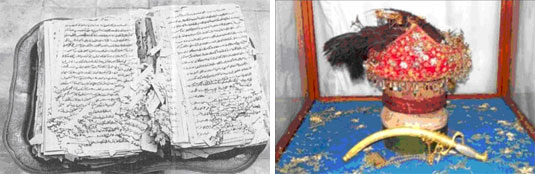
Among the collection of various relics of European nations, the museum also has a unique and sacred crown that no other castle in Indonesia has, even in the world. It is because this crown has hair that can grow like human beings so that it becomes an obligation to perform a ritual called “istampa” or crown hair cutting annually, every Eid al-Adha. The crown is estimated to have been living 500 years since the first sultan reigned.


The Sultanate of Ternate – Ternate History Tour


Here, tourists will find various collections of objects ranging from geology, archaeology, ethnography, history, numismatics / heraldic, philology, technology, fine arts, to ceramics. To visit this place, visitors are free of charge.

This museum was built on 24 November 1813 by Sultan Muhammad Ali with an area of 1500 m² on a land area of 1.5 ha. In 1981, the management of the building was handed over to the Ministry of Education and Culture although in daily life it is still used as a residence of the Sultan. This place was inaugurated in 1982 by the Minister of Culture at the time, David Joesoef.

You can go around the museum to enjoy a variety of heritage objects of the Sultanate and European settlers here. Facilities available are permanent exhibition and at the same time for collection storage. There is a magnificent golden throne of Sultan Ternate displayed in this museum. In addition, you can also see the equipments for ceremonies and sultanate events.


The Sultanate of Ternate – Ternate History Tour


Inside the palace, you can see the relics belonging to the sultanate which are typical and have historical value, such as the crown and the Quran in the oldest handwriting in Indonesia, and many war equipment. You can also observe the sultan crown with a number of gemstones, gold, silver, diamonds, mira diamonds, emeralds and sapphires. In local language, Ternate indigenous people call the crown “stampa”.

In front of the palace, there are Sunyie Ici field and Sunyie Lamo that are usually used for ceremonial processions.

Ternate influences as a kingdom with a long history are still felt. Ternate has a large contribution in the eastern part of Indonesian culture, especially Sulawesi (north and east coast) and Maluku. The influences include religion, customs and language. Sultanate government and the implementation of Islamic law which was first introduced by Sultan Zainal Abidin later became the standard that is followed by all the kingdoms in Maluku.

Besides, the success of the people of Ternate under the Sultan Baabullah in ousting the Portuguese in 1575 was the first victory of the native Indonesian on the Western powers. Ternate's victory has postponed Western colonialism in Indonesia for 100 years, at the same time strengthen the position of Islam in Eastern Indonesia.

To reach Ternate Sultanate Palace Memorial Museum is very easy. From Sultan Baabullah airport, a trip to the museum is as far as 3.5 km. From Port Ahmad Yani, the distance is about 1.5 km. If you go via Gamalama Station, the distance is only about 0.5 km.

The Sultanate of Ternate - Open Hour:

Monday s / d Tuesday: 09:00 to 17:00 local time
Saturday: 9:00 to 3:00 p.m. local time
Sunday: 09:00 to 13:00 local time

Fort Kota Janji (Fort City of Promise) – Ternate History Tour

Fort Kota Janji (Fort City of Promise) – Ternate History Tour

Fort Kota Janji (Fort City of Promise) is located on Ngade Street, Laguna Hamlet, Fitu Village, South Ternate District, North Maluku province. The location of this fort is on the edge of the main road to Ternate from the south.

Historically, Fort Kota Janji was built in 1532 by the Portuguese and named Fort San Jao. However, since the murder of Sultan Khairun of Ternate, the Portuguese were expelled from Ternate Island by the Sultanate of Ternate, who was led by Sultan Babullah in 1575. The fort was later occupied by Spanish troops under Governor Don Pedro de Acuna who came from Manila in 1606 and intended to control Ternate Island.

In 1610, this fort was reinforced by Spain by putting 27 soldiers and 20 papangger soldiers (soldiers consisting of Filipinos) along with 6 cannon and its ammunition. This fort was later named Santo Pedro Y Paulo, in honor of Governor Pedro. In addition to overseeing the sea between the island of Ternate and Tidore, this fort was also used by the Spanish as a military base. If the sea condition was calm, the Spanish fleet that sailed from the Philippines could anchor on the coast in the south of the fort. It also eased them for mobilizing their troops and logistics to this fort.

This trapezoid-shaped fort measured 20 x 20 m, built on a land with area of ​​2147.25 m², at a height of 50 m above sea level. The fort, which was said to be magnificent, has now collapsed. Part of the fort that can still be seen now is just the outer wall composed of stone (andesite), reefs, and sand mix with lime, while the inside has been buried with soil. On the east side of the fort, there is a stair that leads up to the top of the fort where there is a kind of pool that has dried up.

This fort is later known as Fort Kota Janji (Fort City of Promise) until now. It was named like that because the fort had been the witness of a peace treaty between Sultan Khairun and the Portuguese governor at that time, Diego Lopes de Muspito. However Portuguese broke the treaty and betrayed by killing Sultan Khairun in Fort Kastela, not far from the Fort Kota Janji.

In 1989, this fort looks abandoned and left alone. The sand digging around the fort was also neglected until abrasion occurred and most of the fort inundated by sea water. Only in 1994, the fort was re-restored by the Ministry of Education and Culture so it is fully recovered without losing the original shape of the fort.

Many natural beauties can be enjoyed from this fort which has 4 bastions and a well. The view shown from the fort is a stretch of islands in front of Ternate. One of them is the view of Tidore Island and Maitara Island that is depicted on Indonesian 1,000 Rupiah banknotes.


This fort was rehabilitated in 2004, but only to save the cultural heritage area by beautifying the area as a tourist destination. Some fences are built to surround the fort and the park, while the actual form of the fort cannot be seen anymore.

Fort Kalamata – Ternate History Tour

Fort  Kalamata – Ternate History Tour

Fort Kalamata is built by the Portuguese in 1540, which you can find in Ternate, North Maluku province. Fort Kalamata is also called as Red Wood Fort (Benteng Kayu Merah) because it is located in Kelurahan Kayu Merah (Red Wood Village), South Ternate. The fort was originally named Santa Lucia, but became known as Fort Kalamata, which came from the name Prince Kalamata, the younger brother of the Sultan of Ternate Madarsyah.

History
Fort Kalamata was first built by the Portuguese (Francisco Serao) in 1540 to face the Spanish attack of Rum, Tidore. Later, the fort was restored by the Governor General of the Netherland Indies, Pieter Both, in 1609. Fort Kalamata was occupied by the Spanish in 1625 after emptied by Geen Huigen Schapen (Portuguese). After Spain left, the fort was occupied by the Dutch. Then the fort was repaired by Major Lutzow in 1799. In 1994, Fort Kalamata was restored by the Government of Indonesia and inaugurated in 1997. In 2005, the Government of Ternate renovated this fort by building yard and house for the guards.

Construction
Fort Kalamata is designed to resemble the four compass points that which has four bastions pointed end and viewfinder holes. This fort is located on the coastline, and from the back of the fort we are able to see Tidore island and Maitara island.

Fort Kastela– Ternate History Tour

Fort Kastela– Ternate History Tour

Fort Kastela is a Portuguese heritage fort which also known as Fort Gamlamo. Fort Kastela is located on Jalan Raya Benteng Kastela Santo Paulo, Kastela Village, Pulau Ternate District, Ternate, North Maluku province. This fort is located on the north side of Kastela Beach.

According to historical records, after the Portuguese conquered Malacca in 1511, Admiral Alfonso d'Alburquerque sent Antonio de Abreu and Francisco Serrao by fleets consisting of three ships to Maluku in December 1511. In January 1512, they arrived in Banda. After some time in Ambon, the ship carrying Serrao wrecked, and then he was picked up by Sultan’s delegation and was taken to Ternate in early 1512.

The arrival of Francisco Serrao in Ternate was the first arrival of a European official - in this case the Portuguese - from an exploration of the Portuguese authorities that is ambitious and had started since the mid 15th century. The expansion of the Portuguese to Maluku is in purpose to find the spice islands. They seemed to gamble with fate and risk in order to obtain a commercial monopoly of spices which became a luxury commodity in the European market and promised a fantastic profit at that time. Thus, they maintained it with all their power and efforts, whether political, economical, and even military force.

Francisco Serrao is a first functionary Portuguese who successfully negotiated the monopoly rights of his country over the spice trade and the exclusive rights to establish a Portuguese fort in Gamlamo with SultanTernate, Sultan Bayanullah (Boleif).

Finally, in 1520, King of Portugal, Don Manuel, sent Jorge de Brito to build a Portuguese fort in Gamlamo, Ternate, and picked Jorge de Brito’s brother, Antonio de Brito, as commander of the fortress. The built Portuguese fort was named Nostra Senhora de Rosario (Beautiful Women with Roses Necklace), but better known as Fort Gamlamo by local people, and the name has changed to be Fort Kastela because of its location in Kastela Village.

Kastela fort was built gradually by the Portuguese for approximately 20 years. After completing the early stage construction of this fort, Jorge de Brito back to Goa (West India) in 1521 but before getting there, he had been killed in a battle in Aceh. Then the construction is continued by Garcia Henriquez in 1525. In 1530, Gonsalo Pereira took his turn to continue the construction, until in 1540 the fort was completed by Jorge de Castro.

Until 1569, Fort Gamlamo is the only fort that stands outside Malacca. After that, other new forts were built in Ambon, Jailolo, Moro (Tolo and Samafo), Banda and Makassar. However, those new forts seems more like a twin house than a real fort. At those forts, there is no captain who was appointed by the King of Portuguese, like on Fort Gamlamo in Ternate.

On February 27, 1570, the murder of Sultan Khairun Jamil occurred cruelly in this fort by Antonio Pimental, on the orders of Diego Lopez de Mesquita, the 18th Portuguese governor, with trickery and deception.

Babullah, heir to the throne of the Sultanate of Ternate, sued Diego Lopez de Mesquita to be put on trial and convicted for the crime of murder. As the sue was rejected, Babullah and the people of Ternate besieged Fort Gamlamo for 4 years (1574-1578) and issued an ultimatum that the Portuguese left Ternate immediately. In such condition, a massive evacuation from Ternate of the Portuguese began, first they went to Tidore as a transit point, and then to Goa. When Portuguese reinforcements from Goa and Malacca arrived, it was already too late. The leadership of the Portuguese fleet could only watch the debris of Portuguese authority in Ternate. Governor and his apparatuses, missionaries and other Portuguese people had left Ternate, lamenting their lost and their past which is full of violence, arrogance and bloodshed. They left, bringing bad memories they never imagine before that they have to face the end of their reign miserably.

In 1606, Spanish Governor Don Pedro da Cunha invaded and took control of this fort. However, since VOC ran their commercial activity intensely, Spain was not able to compete with it, and only able to survive because of the generosity of the Dutch Governor in Ternate. Therefore, in 1662 the Spanish authorities in Manila decided to close their garrisons in Maluku and pulled back their troops from Maluku to face massive invasion of Chinese pirates who wanted to take over Manila. In 1663, the withdrawal of Spanish troops from Maluku started, and before dispatched to Manila, the Spanish troops had burned Fort Gamlamo in order not to be seized by the Netherlands.

Fort Kastela has a land area of 2,724 m² with a rectangular shape, and is composed of basalts and limestones. Parts of Fort Kastela that can still be identified are only the bastion and the tower, while the rest is only rubble. However, the first fort of Portuguese heritage still shows its grandeur upon the rubble.

In the past, there is a bell in this fort, made by Perio Diaz Bocarro in 1603, imported directly from Portugal. When the Portuguese left Ternate, the historical bell was moved by VOC and hung at the entrance of Fort Oranje until 1950. And since 1951, it was transferred to the Catholic Church in Ternate (Stone Church / Gereja Batu) and stored. But now the bell was no longer in that place.

Museum of the Sultanate of Tidore "Sonyine Malige" - Tidore History Tour

Museum of the Sultanate of Tidore "Sonyine Malige" - Tidore History Tour

Sonyine Malige Museum is the only museum in Tidore, North Maluku province. The museum is filled with history from which you can find a variety of interesting collection of relics of the Sultanate of Tidore. Tidore is one of spice islands in North Maluku which being a seizing for the Portuguese, Spanish and Dutch in the past.

In this museum, there is also a "haired-crown" of the Sultanate of Tidore which is believed that the hair attached on the top of the crown grows each year. So every Eid night they always hold a haircut ceremony. The ceremony is held for seven days. The crown is also used to select candidates for the Sultan of Tidore. According to the elders story, every descendant son of sultan should try the crown. The crown can be fitted on the head of a candidate of the Sultan.

Museum Kesultanan Tidore "Sonyine Malige" - Wisata Sejarah Kota Tidore

Sonyine Malige Museum is built on an area of 800 square meters with a building area of about 300 square meters. The collections that you can find in this museum, such as the throne of the sultanate, sultan’s spittoon (ketur), traditional clothing of the sultanate, the sultanate cap, armaments, Tidore handicrafts, potteries, traditional houses, blacksmith tools, hunting equipments, and so on. In the museum there is also an ancient handwriting Quran which is one of the oldest Quran in Tidore.

The "Haired-Crown" of the Sultanate of Tidore is stored in a Praise room, sacred by the inhabitants of the sultanate. Unfortunately, not just anyone can enter the room. In fact, the Sultan and the Empress just occasionally pray in that room. Usually, when the Sultan and the Empress have a special wish, they pray in that room.

Sonyine Malige Museum becomes more interesting to visit because it contains historical and magical elements.

Fort Tore and Tahula - History Tour of Tidore


Fort Tore and Tahulu is one of the attractions that you must visit in Tidore. Both of these forts are adjacent and located near Soasio City, Tidore, North Maluku province.

The location of Fort Tore and Tahulu is quite high. In this place, you can clearly see the beauty of the sea that separates Tidore Island and Halmahera Island. You can also see Soasio City which was built by Spanish sailors "Sebastiano De Elaco" during colonial times in the past century and becomes the Capital City of Tidore at this time. These forts is quite difficult to reach and you have to expend your energy to climb the stairs to these forts. However, all your hard work will pay off when you arrive at these forts because of its beauty. The location is also very suitable to see the sunrise in the morning.


Fort Tore and Tahula - History Tour of Tidore

Fort Tahula is already in poor condition. Meanwhile, in Fort Tore you still can find the remnants of the fort, which is currently under renovation. When exactly the year of the construction of these forts is unknown . A few centuries ago, these forts became a strategic place to monitor the movement of their enemies who try to attack the Portuguese headquarter.

Fort Tore and Tahula - History Tour of Tidore

Gurabunga Village - Tidore Attractions

Gurabunga Village - Tidore Attractions

Gurabunga, in Bahasa Indonesia means flower garden, which is located on Tidore Island, North Maluku province. Colorful flowers growing in the yard of residents in Gurabunga Village beautify to the beauty this lovely clean village.

Gurabunga has cool temperature, due to its location at an altitude of 800 meters above sea level. The land of this village is fertile, because it is located on the slopes of Kie Matubu, a mountain with height of 1,730 meters above sea level. Kie Matubu is known by the people of North Maluku Province as Mount Tidore.

Gurabunga Village - Tidore Attractions
Desa Gurabunga di lereng Kie Matubu. (Sumber: Blog Ilham Arch)

Besides its beauty, the variety of life, religious backgrounds and cultures of the local residents make this village has many advantages for tourism.

In Gurabunga Village, there are traditional houses, named Folajikosabari, formed of bamboo and ground floors. When you look from afar, the shape of this house resembles a man sitting with legs crossed. Uniquely, this house is also bold with the nuances of Islam. This traditional house has 5 rooms, according to the time of Muslim worship prayer, and have 2 bunches on each bamboo, which symbolizes the two sentences of syahadat.

Gurabunga Village - Tidore Attractions

The traditional house is belonging to the sowohi, which are already hundreds of years old, known as the house of praise. The sowohi's traditional house is known as a medium that connects the spirit world of the ancestors to the sultanate. So that the Sultanate of Tidore takes a lot of decisions by the results of their communication between the sowohi and the spirits of the ancestors. So not surprisingly, a new Sultan of Tidore will be sworn in by the sowohi before in the Sultanate.

Gurabunga Village is also the starting point to climb the peak of the beautiful and fascinating Mount Kie Matubu.

Traditional House "Sasadu" - Culture of West Halmahera

Traditional House "Sasadu" - Culture of West Halmahera

"Sasadu" is traditional house of Sahu Tribe which can be found in West Halmahera regency, North Maluku province. Sasadu is formed of wood and woven sago leaves. This traditional house becomes a place of residents for gathering, dining, and carrying out ceremonies or celebrations.

Traditional House "Sasadu" - Culture of West Halmahera

Sasadu reflects the characteristics of Sahu Tribe: open and friendly. A building without door is a sign that anyone can enter the house, either indigenous people or newcomers from different lands will be welcomed with open arms. It also implies there is no compulsion in communication between people. All goes natural and humble.

This traditional house has six entries to in and out, though each side is not walled. Two entries for women, two entries for men, and two entries for guests. The roof of each Sasadu is carved at both ends in the shape of a ship’s bow and stern. The ridge of the roof symbolizes a sailing boat
, as Sahu Tribe were traditionally a sailing tribe. A replica of a sailboat is also placed in each Sasadu, which is called kagunga tego-tego (a warship on dry land).

Traditional House "Sasadu" - Culture of West Halmahera

On the ridge of the roof, there are two spheres wrapped in fibers. These symbolize the two supernatural forces believed in by the Sahu tribe: Destruction and Protection. This house is built without a nail, but only uses natural materials and local wisdom. It is dominated by sago tree trunks as pillars and columns, woven sago leaves as the roofs. Sago tree is symbolized as tree of prosperity.

Traditional House "Sasadu" - Culture of West Halmahera

Sasadu for Sahu tribe is a form of respect for women. That is the reason why there are two tables in sasadu, one table for women in the front and another table for the men in the back. Placing women at the front table means that for Sahu tribe, women will take precedence and men always protect them from behind.

Traditional House "Sasadu" - Culture of West Halmahera

Additionally, sasadu has a lot of functions. Besides for meeting and receiving guests, it can also be used for celebrating traditional parties, such as marriages and births, which can last for seven days in a row. The dining events are usually held together with traditional dances in front of house. 

Orom Sasadu
Sahu Tribe has good farming skills. Two times a year, Sahu Tribe will hold a ritual for grateful of their rice harvest. This harvest festival is known as Orom Toma Sasadu. "Orom" means "eat", "Toma" means "at", and "Sasadu" means "traditional house". Sahu people will eat, drink and dance as the embodiment of their gratitude to the abundance that is given by God. Orom Sasadu is believed by the ancestors will make the next harvests continue to abound. 

In the past, Orom Sasadu was held for 7 days and 7 nights. The length of the ritual must be in odd numbers, i.e. 7 days and 7 nights, 5 days and 5 nights, 3 days and 3 nights, or just a day and a night. Ritual for 7 days 7 last night was held in 1963. But this time, the ritual has been shortened because now the people have to work.

There is a uniqueness in this ritual which is told by the elders. During the 7 days and 7 nights party, they never sleepy, never full even if they ate continuously, and never drunk though they drank high alcoholic drinks.

Traditional House "Sasadu" - Culture of West Halmahera

Sahu Tribe also has Tifa, a typical music instrument which made of nira wood. This instrument is hung by rope at Sasadu's pillars. The accompanied instrument of Tifa is gong, they can be played in slow, rather fast, and very fast rhythm. At a traditional feasts, poeple of Sahu Tribe, from young people to elders will dance together near the instrument.

Rumah Adat Sasadu - Wisata Budaya Halmahera Barat
Music Instrument - Tifa

Traditional House "Sasadu" - Culture of West Halmahera

During Orom Sasadu, both guests and the residents who participate will be given Saguer and Cap Tikus (alcoholic drinks) alternately. Uniquely, people who drank the alcoholic drinks never fight or being rude. Oppositely, they look really enjoy by singing and dancing.

Sasadu can be found in Jailolo, Sahu, and East Sahu Sub-district. People of West Halmahera are so humble to tourists.